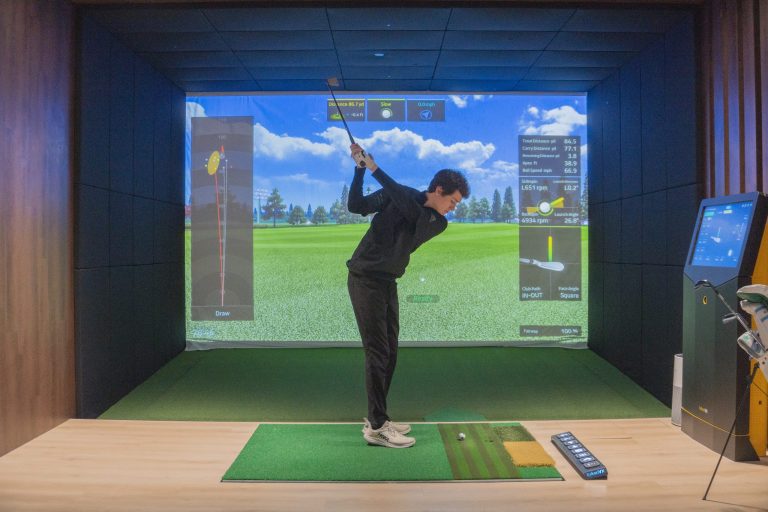
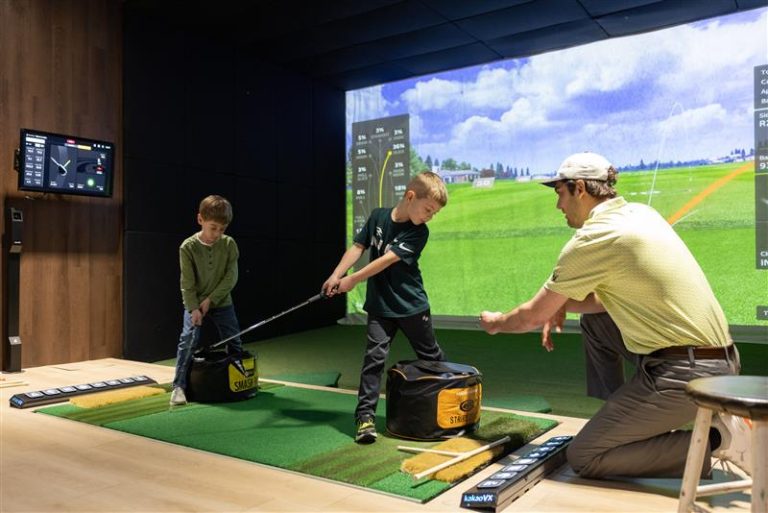
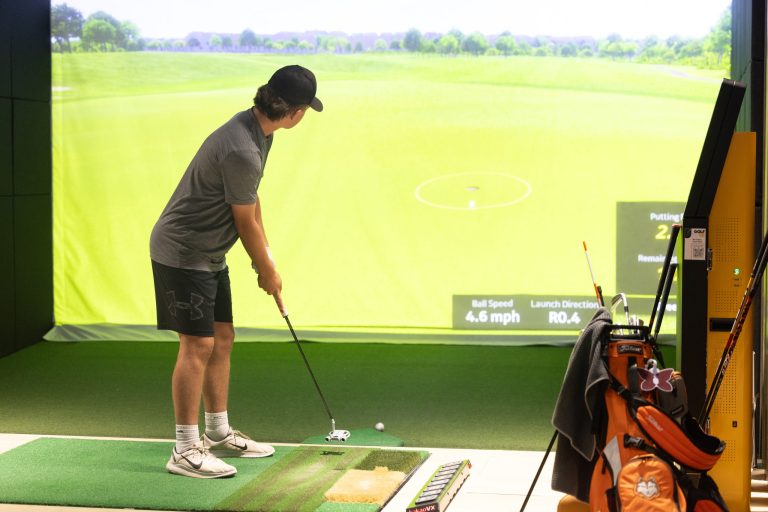
Indoor golf simulators are replacing driving ranges because they deliver more accurate ball data, work regardless of weather or daylight, and fit into a round that takes under an hour instead of a half-day trip to a course. For golfers who play year-round – especially in places like Massachusetts and Georgia where winter shuts down outdoor ranges for months – that combination is why “golf sim near me” searches keep climbing.
Indoor golf isn’t a backup plan for when the range is closed. For a growing number of golfers, it’s become the primary way they practice, compete, and spend time with friends.
Indoor Golf Simulators vs. Driving Ranges: What Actually Changes?
On paper, both indoor golf simulators and driving ranges sound like the same thing: hit a ball, see where it goes, do it again. In practice, the experience diverges the moment contact happens: one method shows you a result, the other shows you the mechanics behind it. That distinction is worth breaking down before comparing cost or convenience, because it’s the reason golfers switch in the first place.
The gap between the two isn’t really about location; it’s about what each one is built to measure. A range tells you where the ball landed; a simulator tells you what your swing did to put it there. Here’s how that plays out across the details that matter most to a practicing golfer.
| Factors | Driving Range | Indoor Golf Simulator |
| What it measures | Where the ball lands after flight | Clubhead speed, launch angle, spin rate, and carry distance at contact |
| Feedback timing | After the ball lands downrange | Instantly, at the moment of impact |
| Weather dependency | Closed or limited in rain, wind, extreme cold | Unaffected, same conditions year-round |
| Daylight dependency | Session ends at sunset unless lit | Fully lit regardless of time of day |
| Data per shot | Little to none on most public ranges | Detailed metrics on every swing |
Are Golf Simulators More Accurate Than Driving Ranges for Practice?
For swing analysis, yes. Modern simulator systems capture ball and club data on every shot – something almost no public driving range offers – which means a golfer can see exactly what changed between a good shot and a mishit instead of guessing from where the ball landed. That data feedback loop is the main reason golfers who start using simulators for practice rarely go back to hitting blind buckets of range balls.
Why Golfers Choose Indoor Simulators for Practice
Once golfers get used to seeing real data on every swing, going back to a bucket of range balls starts to feel like practicing blind. Here’s why indoor golf has become the preferred way to practice for many golfers.
- Practice Without Weather or Daylight Restrictions: A session happens on schedule, not on whatever the forecast allows
- Get Immediate Feedback on Every Shot: No walking downrange or guessing why a shot went sideways
- Spend Less Time Driving to and From the Range: A bay near home cuts out the commute that eats into an actual practice window
- Practice Specific Parts of the Game: Dial in on a weak spot instead of hitting the same full swing over and over
- Repeat the Same Shot and Compare Results: See side-by-side data across attempts instead of relying on memory
How Does a Golf Simulator Calculate Distance and Ball Flight?
Simulators use a combination of camera and radar sensors positioned near the hitting area to track the ball in the first few feet after contact, along with clubhead data captured on the swing itself. From that data, the system calculates carry distance, total distance, launch angle, golf spin rate, and shot shape, then renders the result on a simulated course or driving range screen. Because the calculation happens at impact rather than from watching the ball land downrange, the feedback is available instantly, even indoors where the ball never actually travels its full distance.
Indoor Golf vs. Driving Range: Cost, Time, and Value
Price-per-bucket and price-per-bay work differently once you factor in group size and how often someone actually practices. Here’s how the two stack up side by side.
| Factors | Driving Range | Indoor Golf Simulator |
| Pricing model | Per bucket of balls | Per bay, per hour |
| Cost for groups | Each person pays separately | One cost split across 2–4 golfers |
| Frequent-use option | Rarely discounted | Memberships often lower cost per visit |
| Time per session | Variable, dependent on range traffic | Typically under an hour for a full round |
| Value for data-driven practice | Limited, no shot data included | High, detailed metrics included in the session |
What Should a Golfer Expect to Spend On Indoor Golf Versus a Driving Range?
Driving ranges typically charge per bucket of balls, which is cheap per session but adds up with frequent use and doesn’t scale for a group. Indoor golf venues generally price by the bay per hour, which means a group of two to four golfers splits one cost rather than each buying a separate bucket. For golfers who practice multiple times a month, is golf simulator membership worth it? Is an accurate question, as many venues also offer memberships that bring the effective per-visit cost down further. Exact pricing varies by location and package, so checking a specific venue’s rates is the best way to compare.
Is Indoor Golf Just for Practice, Or Is it Social Too?
An indoor golf simulator isn’t confined to practice alone but also offers an opportunity to socialize with your loved ones. The same simulator bay that supports serious practice also runs league nights, casual rounds with friends, and food-and-drink social sessions. Because shot data levels the playing field between beginners and experienced golfers, it works as well for a family outing or indoor golf for kids as it does for a golfer training seriously.
At Golf VX, that versatility is the point: the same bay that hosts a competitive tournament one night hosts a casual round with friends the next. Memberships give regular players ongoing access to both.
Can Indoor Golf Simulators Actually Improve a Golfer’s Handicap?
Golfers who use simulators consistently tend to improve faster on specific, fixable issues, clubface angle at impact, swing path, and distance control, because the data isolates exactly which part of the swing caused a bad shot instead of leaving the golfer to guess. Best golf courses to play on a simulator are a great way for most serious golfers to fix mechanics, and then apply them on the course.
Is indoor golf faster than playing an outdoor range or course?
Yes. A full simulator round typically runs under an hour, compared to a half-day commitment for eighteen holes outdoors or the drive-and-wait involved in an outdoor range visit. For golfers fitting practice around work or family schedules, that time difference is often the deciding factor over accuracy or atmosphere.
Indoor golf keeps growing because it removes the constraints that limit outdoor practice – weather, daylight, distance, and vague feedback – while adding the kind of data and social format that makes people want to come back. If you’re new to the format, here’s exactly what to expect your first time. To find a bay near you, explore Golf VX locations in Arlington Heights, North Dartmouth, and Duluth.
Improve Your Golf Game with Golf VX Indoor Golf Simulators
Ready to see what your swing actually looks like on the way to the green? Golf VX makes it simple to find a bay, book a session, and start training with real shot data instead of guesswork. With locations in Arlington Heights, North Dartmouth, and Duluth, Golf VX gives golfers year-round access to practice, leagues, and casual rounds, all in one indoor setup that doesn’t care what the weather’s doing outside. Memberships are available for regular players who want ongoing access at a lower per-visit cost, whether the goal is fixing a specific swing flaw, hosting a night out with friends, or just getting more reps in before the season starts. Book a bay and see the difference real feedback makes.
Conclusion
The shift toward indoor golf isn’t about novelty; it’s about golfers realizing they can practice smarter, more often, and on their own schedule. A simulator hands you the data a driving range never could, strips out the weather and daylight excuses, and turns an hour into a full, useful session instead of a half-day commitment. Whether you’re chasing a lower handicap or just want a reliable place to play with friends, Golf VX gives you the tools and the venues to make that happen year-round.
FAQs
Is An Indoor Golf Simulator Better Than a Driving Range?
For swing feedback, yes. Simulators capture clubhead speed, launch angle, spin rate, and carry distance on every shot, data most driving ranges don’t provide. Ranges only show where the ball lands. Simulators also work regardless of weather or daylight, which ranges can’t offer.
How Much Does It Cost To Use a Golf Simulator Instead Of a Driving Range?
Simulator venues typically charge per bay, per hour, which a group can split, rather than per bucket of balls charged per person at a range. Frequent players often save more with a membership. Exact pricing varies by venue, so checking current rates for your location is recommended.
Can Beginners Use a Golf Simulator?
Yes. Simulators display shot data for every player regardless of skill level, which makes it easier for beginners to see and correct mistakes than guessing from ball flight outdoors. Many venues also offer lessons and clinics specifically for new golfers.
Do Golf Simulators Work As Well As Outdoor Ranges For Practicing Club Distance?
Simulators use ball-flight sensors to calculate carry and total distance per club, which is generally accurate enough for practice and club selection. Conditions like wind and altitude aren’t factored in the same way they affect an outdoor shot, so real-course distances can vary slightly.
Is Indoor Golf Available Year-Round Regardless Of Weather?
Yes. Indoor golf simulator venues operate entirely indoors, so snow, rain, heat, or darkness don’t affect availability. This is the main reason indoor golf usage rises in winter and in regions with limited outdoor golf seasons, like Massachusetts.
Can a Golf Simulator Help Lower a Golfer’s Handicap?
Simulators can speed up improvement on specific mechanics like swing path and clubface angle because the data pinpoints the cause of a bad shot. They don’t replicate real-course conditions like uneven lies or wind, so most golfers pair simulator practice with on-course play for full improvement.
How Long Does a Typical Indoor Golf Session Take?
A full simulator round usually takes under an hour, much shorter than an outdoor round of golf, which typically requires four to five hours. This makes indoor sessions easier to fit around work, family, or a single free evening.
What Golf Data Does a Simulator Track That a Driving Range Doesn’t?
Simulators track clubhead speed, launch angle, spin rate, carry distance, and total distance on every single shot, captured at the moment of impact. Most public driving ranges provide none of this data, since they only show where the ball lands downrange.
Is a Golf Simulator Membership Worth It Compared To Paying Per Visit?
For golfers who play more than a few times a month, a membership usually lowers the effective cost per session compared to paying per visit or per bucket at a range. It also typically includes access to leagues and events not available to single-visit guests.
Do Indoor Golf Simulators Work For Practicing With Kids Or Beginners?
Yes. Because the format doesn’t require retrieving balls or managing an open range, and games can be adjusted for difficulty, simulators work well for kids and first-time golfers alongside more experienced players in the same session.