| Quick Summary:
Golf spin rate is how fast the ball rotates immediately after it leaves the clubface, measured in rpm. It is one of the biggest factors in how far and how high your ball flies. This guide breaks down what spin rate actually is, what the ideal numbers look like for every club, and what you can do to bring yours closer to where it should be. |
I’ve seen plenty of golfers who can tell you their swing speed down to the mph, but have never once looked at their spin rate. It’s one of those numbers that sits quietly in the background of every shot, and most players never think about it until someone shows them how much it’s actually costing them. A driver spinning at 4,000 rpm instead of 2,400 can lose you 20+ yards, even if your swing speed hasn’t changed at all. That’s the kind of number worth understanding. Thus, to understand this in detail, let’s walk through what spin rate is, why it matters more than most golfers realize, & what the ideal numbers look like club by club.
What is Golf Spin Rate?
Spin rate golf refers to how fast the golf ball is rotating around its axis the moment it separates from the clubface, measured in revolutions per minute (rpm). It’s generated by a combination of clubhead speed, the loft of the club at impact, and where on the face you make contact. Spin rate directly shapes the trajectory of your shot, how high it climbs, how far it carries, and how it behaves when it lands. Every club produces a different spin rate by design, and understanding your numbers tells you a lot about both your equipment and your technique.
Why Golf Spin Rate Matters in Your Golf Game?
Ideal driver spin rate isn’t just a number on a launch monitor screen; it directly shapes outcomes you can see & feel on every shot you play on Golf VX simulators. Here’s what it actually influences once you start paying attention to it.
- Distance: Too much spin on a driver creates drag and kills carry distance, sometimes by significant yards, even with a strong swing speed.
- Carry distance: The right spin rate keeps the ball in the air longer relative to its speed. This maximizes how far it travels before landing.
- Rollout: Lower spin shots land and run further. Higher spin shots land softer and stop quicker. This significantly changes how you plan approach shots.
- Shot control: Spin is what lets skilled players shape shots intentionally; fades, draws, and stopping power on the green.
- Green-holding ability: Without enough spin on your irons and wedges, approach shots release and roll off the back of the green.
- Performance in wind: High-spin shots balloon and get pushed around more in windy conditions. Whereas lower spin shots fly more penetratingly and stably.
How Spin Rate Affects Ball Flight?
The relationship between spin and ball flight isn’t a simple “more is better” or “less is better”, it depends entirely on what you’re trying to achieve with that particular club and shot. The comparison below shows the trade-offs at a glance, and the explanations after it cover what happens at each end of the spectrum, including when spin tips into genuinely problematic territory. Read below in detail!
| Factor | High Spin | Low Spin |
| Control | More control | More rollout |
| Distance | Better stopping power | More distance potential |
| Trajectory | Higher flight | Lower, more penetrating flight |
Low Spin
Low spin produces a flatter, more piercing ball flight with significantly more rollout once it lands. For drivers, this generally translates to more total distance, the ball doesn’t fight as much drag in the air. The trade-off is stopping power: a low-spin shot into a green is going to release and run, which can be a problem on firm or fast greens where you need the ball to hold.
High Spin
High spin sends the ball higher into the air with more carry relative to its speed, and it stops much faster on landing. This is exactly what you want from a wedge into a green. The ball climbs, holds its line, and sits down close to where it lands. On a driver, though, this same characteristic works against you, robbing distance you’d otherwise have.
Excessive Spin
This is where things go wrong. Excessive spin, let’s say on a driver, causes the ball to “balloon,” climbing too steeply and losing forward momentum. The result is a shot that looks impressive in the air but comes up noticeably short. Driver spin above roughly 3,000 rpm starts to fall into this territory for most amateur swing speeds, and the distance loss compounds quickly the higher it climbs.
Backspin vs Sidespin vs Total Spin
Spin isn’t just one number; it’s actually a combination of different spin components working together. Thus, understanding the difference helps explain why two shots with the “same” spin rate can behave completely differently in the air.
- Backspin: It is the spin that lifts the ball and creates stopping power. Backspin is the dominant component on a well-struck shot and the one most commonly referred to when people say “spin rate.”
- Sidespin: This is what curves the ball left or right. Too much sidespin relative to backspin is what produces a slice or a hook.
- Spin axis: The side axis describes the tilt of the spin. A perfectly vertical axis produces a straight shot, while a tilted axis curves the ball, and the degree of tilt determines how much it curves.
- Total spin: It combines backspin and sidespin into a single number. It’s the figure most launch monitors display by default, and it’s what determines the overall amount of curve and lift on a shot.
What Should be the Golf Spin Rate for Each Club
Golf ball spin rate naturally increases as you move from driver to wedges; more loft means more spin, by design. The numbers below reflect typical ranges of golf ball spin rates by club for golfers using modern equipment and premium balls, based on TrackMan spin rate data and PGA Tour averages. They’re a useful benchmark whether you’re checking ideal spin rate for driver or iron numbers on the range or on a GolfVX simulator lesson.
| Club | Typical Spin Rate (rpm) |
| Driver | 2000-3000 |
| 3 Wood | 2800-3500 |
| Hybrid | 3500-4800 |
| 4 Iron | 4000-5000 |
| 7 Iron | 6000-7000 |
| Pitching Wedge (PW) | 7000-9000 |
| Wedges (GW/SW/LW) | 8000-12,500 |
Quick Answer: For a driver spin rate chart, the ideal range for most golfers is 2,000–2,800 rpm. The PGA Tour average sits around 2,500 rpm, and Rory McIlroy’s average is notably lower at around 2,325 rpm, which contributes to his exceptional carry distance.
What Factors Influence Golf Spin Rate?
Spin rate isn’t random, and it isn’t fixed; it responds to a combination of golf swing mechanics, equipment, and conditions. Knowing what moves the needle helps you figure out whether a spin number that looks “off” is actually a technique issue, an equipment issue, or just normal variation.
- Club loft: More loft generally produces more spin. It’s the single biggest structural factor, which is why wedges spin so much more than drivers.
- Clubhead speed: Faster swings generally increase spin, all else being equal, though the relationship isn’t linear and varies by club.
- Angle of attack: A steep, descending strike on a driver increases spin significantly; an upward golf attack angle reduces it. This is one of the most controllable variables for driver spin specifically.
- Strike location: Hitting low on the clubface increases backspin (gear effect); hitting high on the face reduces it. This is especially pronounced in drivers.
- Groove condition: Worn or dirty grooves reduce spin, particularly on wedges, where groove sharpness is doing a lot of the work.
- Course conditions: Wet conditions reduce spin because moisture gets between the ball and the clubface at impact, particularly with irons and wedges from the rough. However, with GolfVX simulators, you get to do golf simulator practice on 350+ golf courses without weather restrictions.
How to Increase Spin Rate in Golf?
If your numbers, particularly on wedges, are coming in lower than the ranges above, a few practical adjustments tend to make the biggest difference fastest.
- Clean your grooves: Clean before every session; dirt and grass buildup is one of the most common and easiest-to-fix causes of low spin.
- Use premium golf balls: Use the balls with a urethane cover. Distance balls are built to spin less, which works against you on approach shots.
- Improve contact quality: Center-face strikes transfer energy more efficiently and produce more consistent spin than mishits.
- Use proper wedge selection: A wedge with sharper, less-worn grooves and the right bounce for your conditions will spin noticeably more.
- Adjust your attack angle: A steeper, more descending strike with irons and wedges increases spin significantly.
Practice with GolfVX Simulators to Understand & Improve Your Spin Rate
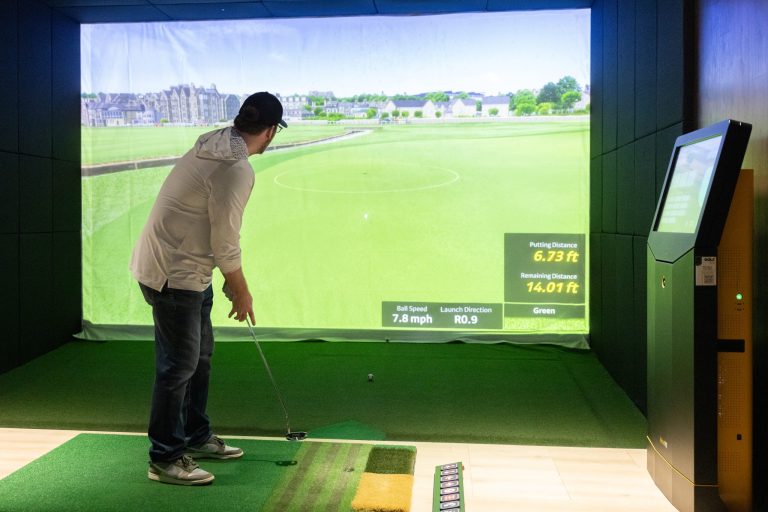
Reading about spin rate is one thing, actually seeing your numbers shot after shot is what makes it click. At Golf VX, every bay is equipped with simulators that capture spin rate, launch angle, ball speed, and carry distance in real time, so you can see exactly where your driver and irons sit against the benchmarks in this guide. Whether you’re working on cutting down excessive driver spin or trying to get more bite on your wedges, having the data in front of you after every swing turns guesswork into a plan. Find a Golf VX location near you, book a bay, and start seeing your real numbers, not estimates.
Conclusion
Golf spin rate is one of those numbers that quietly shapes almost everything about how your ball flies: distance, trajectory, control, and how it behaves once it lands. Once you know what good numbers look like for each club in your bag, it becomes a lot easier to spot what’s actually going wrong with a shot, rather than guessing. Whether your driver is spinning too much or your wedges aren’t spinning enough, the fixes are usually more accessible than people expect, and seeing your real numbers on Golf VX simulators is the fastest way to know where to start.
FAQs
What Is A Good Spin Rate For A Golf Ball?
It depends entirely on the club. For a driver, 2,000–3,000 rpm is the target range for most golfers. When it comes to irons, spin increases with loft. And for wedges, 8,500–10,500 rpm is ideal for control and stopping power around the green.
Is 3000 Spin Too Much For A Driver?
For most amateur golfers, yes. A driver spin above 3,000 rpm typically starts costing distance through excess drag and ballooning ball flight. The ideal range sits between 2,000 and 2,800 rpm, though this can shift slightly based on swing speed and launch angle.
Why Is My 7 Iron Spin Rate So Low?
The most common causes are worn or dirty grooves, hitting too high on the clubface, using a distance-oriented two-piece ball, or wet conditions reducing friction at impact. A 7 iron should typically spin between 6,000 and 7,500 rpm; if you’re well below that, check your grooves and ball choice first.
Do You Want High or Low Spin?
Neither universally, it depends on the club and the shot. Lower spin is generally better for drivers, where it maximizes carry and rollout. Higher spin is generally better for wedges and approach shots, where it provides the stopping power needed to hold a green.
What’s The Difference Between Spin Rate And Spin Axis?
Spin rate measures how fast the ball is rotating overall, while spin axis describes the tilt of that rotation. A vertical spin axis produces a straight shot regardless of spin rate; a tilted axis is what causes the ball to curve left or right.