| Quick Answer: Data-driven golf instruction uses real-time launch monitor metrics, ball speed, club path, spin rate, face angle, and more, to replace feel-based guessing with measurable evidence. Instructors identify swing faults from the numbers, make specific adjustments, and verify them on the next shot. The result is faster, with more accountable improvement than traditional coaching methods. |
Something changed in how good golf instruction works, and it didn’t happen all at once. It happened swing by swing as launch monitors became precise, accessible, and integrated enough into teaching environments that an instructor could stop relying on what a swing looked like and start working with what it actually produced. The difference that makes is harder to overstate. A golfer who slices the ball doesn’t need to be told their swing looks wrong; they already know. What they need is a clear, specific explanation of which variable is causing it and what changing that variable will do. That’s what golf simulator instruction delivers, and it’s why indoor golf lessons built around data have become the format serious golfers seek out rather than settle for.
What is Data-Driven Golf Instruction?
Data-driven golf instruction is exactly what it sounds like: coaching decisions based on measured data rather than observation and feel. Instead of an instructor watching a swing and saying “keep your club flatter,” they look at the launch monitor and see a club path of -8 degrees with a face angle 4 degrees open to that path, producing a left-to-right spin axis that explains precisely why the ball curves the way it does.
Every concept that used to live in feel-based language, “swing more from the inside,” “stay behind the ball,” “get through the shot,” now has a corresponding number. Club path shows swing direction. The golf attack angle shows whether the club is ascending or descending at impact. The golf spin rate explains trajectory behavior. Golf swing data gives coaches a shared, objective reference point that doesn’t depend on either person’s interpretation of a movement they watched at speed.
Benefits of Data-Driven Golf Simulator Instruction
The shift to measurement-based coaching changes what’s possible in a lesson, and what’s possible between lessons when a player practices on their own. Read below how data-driven golf simulator instruction helps golfers:
- Removes guesswork: Both the instructor and the player are looking at the same objective information.
- Faster fault identification: A slice caused by an open face behaves differently from one caused by an out-to-in path; the data separates them immediately.
- Shorter feedback loops: Make an adjustment, swing again, compare the numbers, and confirm whether it worked in the same session.
- League and tournament context: Competing in Play Golf VX leagues and tournaments shows how swing improvements translate under real scoring pressure
- Consistent progress tracking: Session data over weeks shows whether improvement is real or just a good day.
- Better practice between lessons: When a player knows their numbers, they know what they’re working toward on their own.
- Works for all levels: Beginners benefit from understanding cause-and-effect early; competitive players benefit from optimizing specific metrics.
- Memberships that support continuous development: Consistent access to a facility through a golf simulator membership means players can apply lesson changes in structured practice rather than waiting weeks.
What Data Do Golf Simulators Measure?
The metrics a golf launch monitor captures cover two categories: what the club did at impact and what the ball did after leaving the face. Together, they explain ball flight completely. Know in depth what data golf simulators measure:
Ball Speed
Ball speed is the velocity of the ball immediately after impact, measured in mph. It’s the single most direct indicator of how efficiently energy was transferred from club to ball. Coaches use it alongside club speed to calculate smash factor, and it’s the primary predictor of carry distance when combined with launch angle.
Club Speed
Club speed measures how fast the clubhead is traveling at the moment of impact. It’s distinct from ball speed; you can have high club speed and low ball speed if contact is off-center. The difference between the two tells the coach whether a distance problem is about swing speed or strike quality, which are two different problems with different solutions.
Smash Factor
Smash factor is ball speed divided by club speed, and it measures contact efficiency. A driver smash factor of 1.50 is the equipment-legal ceiling and represents a perfectly centered strike. Most amateur golfers sit below 1.45, meaning they’re losing distance not because they’re not swinging fast enough but because of where they’re hitting the face. Improving smash factor without changing swing speed produces real distance gains.
Launch Angle
Launch angle is the vertical angle at which the ball leaves the clubface. For a driver, the optimal range for most swing speeds sits between 12 and 15 degrees; too low and the ball doesn’t carry, too high and it climbs without generating forward distance. For irons, appropriate launch angle varies by club length and the intended shot trajectory. An instructor can immediately see whether a player’s launch is costing them distance or height.
Spin Rate
Spin rate is measured in revolutions per minute and determines how the ball behaves in the air. High spin on a driver produces ballooning shots and distance loss; low spin on a wedge produces a ball that runs through the green rather than stopping. Swing analysis of the golf spin rate also reveals the spin axis; a tilted axis is what produces curvature, and the direction and degree of tilt explain whether a ball is fading, drawing, slicing, or hooking.
Club Path
Club path is the horizontal direction the clubhead is traveling at impact relative to the target line. A positive number means in-to-out; a negative number means out-to-in. Golf club path interacts with face angle to determine the starting direction and curvature of the ball, and it’s the primary diagnostic for players dealing with a persistent slice or hook.
How Golf Instructors Use This Data During Lessons
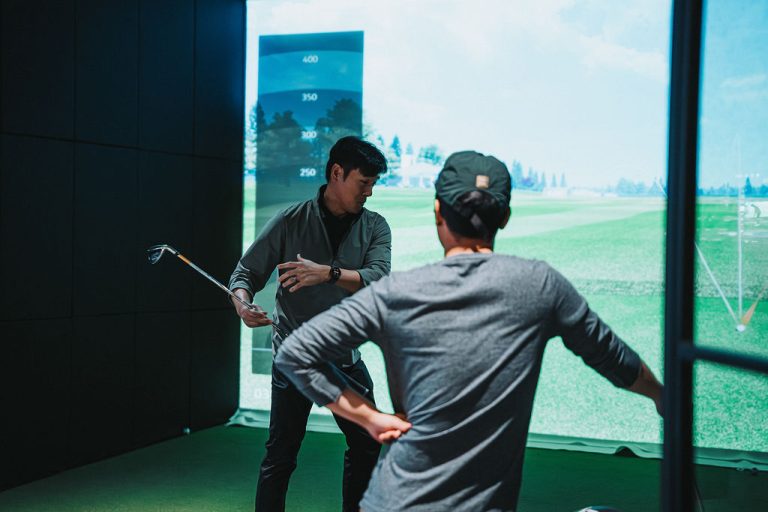
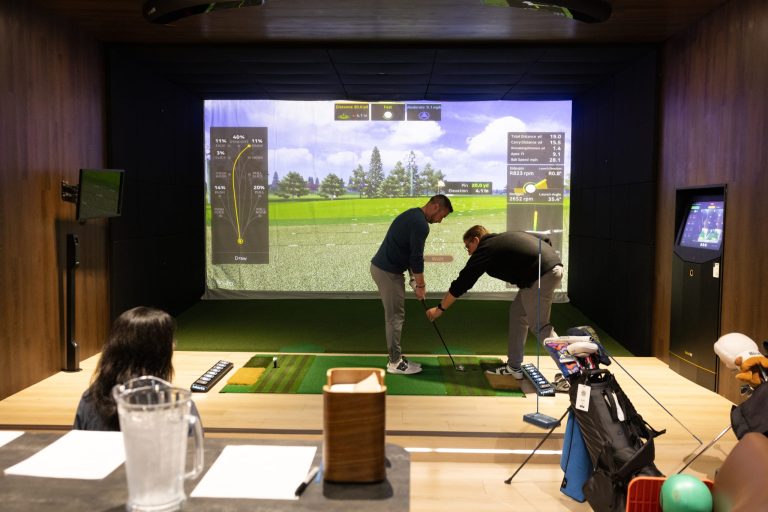
The lesson flow at a data-driven facility is different enough from a traditional lesson that it’s worth walking through. A player steps into the bay and takes a swing. The simulator captures the full data set immediately, from ball speed, club speed, smash factor, launch angle, spin rate, club path, face angle, to carry distance. The golf instructor reviews that data in context with what they observed visually. They identify the primary metric driving the problem and explain what the numbers mean, make a targeted adjustment whether it is improving golf grip, setup, swing thought, or drill, and ask the player to swing again.
Now, as the new numbers appear, if the target metric moved in the right direction, they confirm it and continue. If it didn’t, or moved in the wrong direction, that information is just as valuable. No guessing, no waiting for the next session to see whether the change held. The entire diagnostic and adjustment process happens in real time, which is why if you book a golf simulator lesson, it compresses improvement timelines that used to take months into a much smaller number of sessions.
What to Look for in a Data-Driven Golf Lesson?
Not all launch monitor golf lessons are equal, and knowing what to look for before booking saves time and money.
- PGA-certified or qualified instructor: The data is only as useful as the coach’s ability to interpret and apply it.
- High-quality launch monitor: The underlying golf simulator accuracy of the tracking technology determines how much you can trust the numbers.
- Lesson reports: A written summary of key metrics and recommended changes gives you something to work from between sessions.
- Progress tracking: Session-to-session data comparison is what shows whether the adjustments are holding.
- Video replay: Seeing your swing alongside the data closes the gap between what you think you’re doing and what’s actually happening.
- Specific practice recommendations: A good lesson ends with a clear, focused plan for independent practice before the next session.
How Golf VX Uses Data to Improve Coaching
At Golf VX, data-driven coaching is built into how the facility operates rather than treated as an optional extra. Every bay runs on AI-powered simulator technology that captures the full set of launch monitor metrics on high-quality golf simulators with every swing, giving instructors an immediate, objective picture of what’s happening at impact. Golf VX lessons connect that real-time golf swing analysis to qualified instruction in a private bay environment.
Players working on specific swing changes can book practice sessions to apply lesson adjustments under the same measurement conditions they were diagnosed in, which reinforces changes far more effectively than open-ended range work. For players who want structured development over time, membership provides consistent access to both the facility and its data tools throughout the year, across all seasons, in any weather. And for those who want their improvement tested under genuine competitive pressure, leagues and tournaments run regularly across Play Golf VX locations.
Conclusion
Data-driven golf instruction has changed what’s possible in a lesson, not because it replaced the instructor, but because it gave them something to work with that feel-based coaching never could. The combination of a qualified coach and real-time golf launch monitor data produces diagnostic accuracy and adjustment speed that compress improvement timelines considerably. Whether you’re dealing with a persistent slice, losing distance you can’t account for, or simply trying to understand your swing well enough to practice with purpose between sessions, the numbers tell the story faster and more clearly than anything else available.
FAQs
How Do Golf Simulators Improve Golf Lessons?
Golf simulators improve golf lessons by capturing precise metrics like ball speed, club path, face angle, and spin rate on every swing. Golf simulators give instructors objective evidence to work with rather than visual estimates. Adjustments can be made and verified in the same session.
Are Indoor Golf Lessons Effective?
Yes, particularly for swing mechanics and fault correction. The controlled environment removes weather variables, and the immediate golf swing data feedback makes the diagnostic and correction process faster than outdoor lessons.
How Does Launch Monitor Data Help Golfers?
It identifies the specific metric causing a shot problem: an open face, an out-to-in path, high spin, which leads to a specific fix rather than generic advice. That precision is what accelerates improvement.
Can Beginners Benefit from Data-Driven Golf Instruction?
Yes. Beginners often benefit most because they learn cause-and-effect relationships early, before habits become established. Understanding why a ball curves is more useful than just knowing it does.
What Metrics Should Golfers Focus on During Lessons?
Club path and face angle for directional control, smash factor for contact quality, launch angle and spin rate for distance optimization. Which takes priority depends on what the current ball flight problem is.
Is Simulator Coaching Better Than Traditional Golf Lessons?
For swing mechanics and data-driven improvement, golf simulator coaching has measurable advantages. For short game, on-course decision-making, and putting, real-course practice is still necessary. Both serve different parts of the game.
How Does Swing Analysis Improve Golf Performance?
By identifying which specific metrics are producing poor outcomes, a coach can prescribe targeted adjustments. Players practice the right change rather than experimenting broadly, which produces faster and more durable improvement.
Can Golf Simulator Lessons Lower Your Handicap?
Yes, particularly for golfers whose handicap is held back by specific, repeatable swing faults that the data can identify and address directly. Consistent access to indoor golf lessons combined with structured practice is one of the most direct routes to sustained score improvement.