Most golfers reach a point in their golf game where hitting more balls stops making them better. And there’s a reason for it: the range feels productive, the session feels satisfying, but the numbers on the course don’t move. That’s usually not a commitment problem; it’s a feedback problem. The debate between indoor golf vs driving range practice is really a debate about whether you’re practicing with enough information to actually improve, or just repeating what you already do. Both have genuine value. You can’t consider either of these as the complete answer on its own. But in 2026, understanding what each option actually delivers & where each one falls short, is the key to actually knowing the difference between practice that builds your game & practice that just fills time.
What is Indoor Golf Practice?
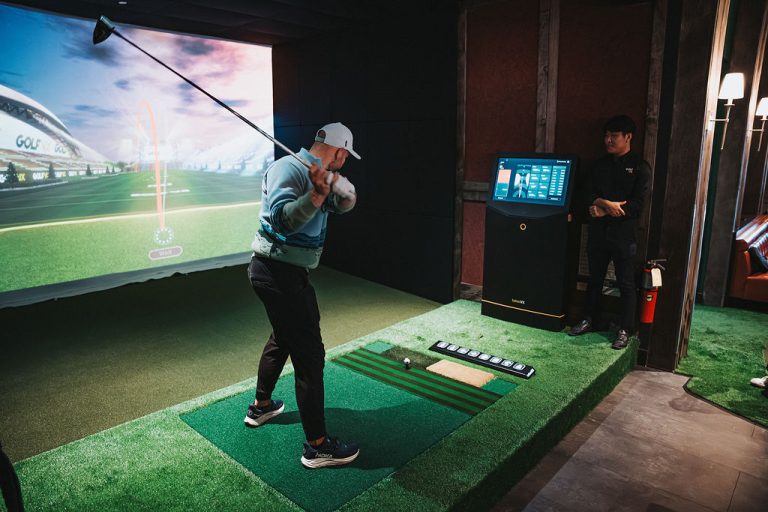
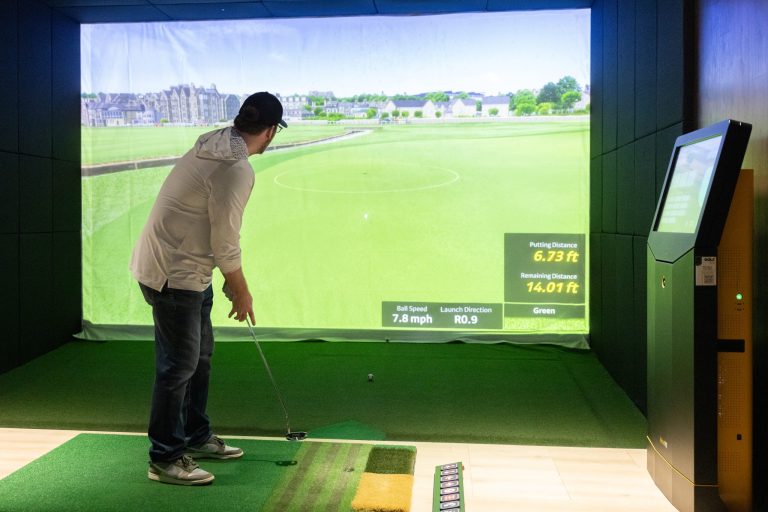
The indoor golf practice uses simulator technology, a setup that includes launch monitors, impact screens, and simulation software, to track every element of your swing and ball flight in real time. Ball speed, spin rate, club path, face angle, carry distance, & your golf attack angle: all of it is measured & displayed on every shot, so that you know what you are actually doing. The environment in indoor golf practice is controlled, the conditions are consistent & the data doesn’t change depending on the wind. For golfers who want to understand what their swing is actually producing rather than just watching ball flight and guessing while practicing, a simulator session gives you answers that the range simply can’t.
What is a Driving Range?
A driving range is the most accessible form of structured golf practice, a facility with defined hitting bays, a grass or mat surface, and target flags at measured distances. You hit real balls into a real space, deal with real weather & develop an instinctive feel for distance, trajectory, and turf interaction. The range has been the foundation of golf practice for over a century for good reason: it’s available, a viable option, and there’s something about hitting a ball outdoors that engages the senses in a way that remains genuinely valuable for course-readiness. For developing timing, rhythm, and the physical habit of a repeating swing, range time still has real merit.
The Key Differences Between Indoor Golf Practices vs Driving Range
The honest comparison between golf simulator vs driving range isn’t about which is better in absolute terms, it’s about which delivers more value for the specific improvement you’re after. A simulator gives you data. A range gives you the feel. And most serious golfers need both. But the differences between what each option actually provides are significant, and they’re worth understanding clearly before you decide where to spend your practice time.
| Factors | Indoor Golf Simulator | Driving Range |
| Accuracy feedback | Instant, precise data on every shot: ball speed, path, face angle | Visual only, as you only watch where it goes and estimate why |
| Ball tracking | Full trajectory tracking from impact to simulated landing | Limited to visual observation; range balls distort real-world data |
| Real-world conditions | Controlled; no wind, no uneven lies, no natural terrain variation | Real turf, real light, real weather; more course-representative |
| Weather dependency | None, it is available year-round, any time of day | Fully weather-dependent; cold, rain, and wind limit the quality of sessions |
| Convenience | Bookable by the hour, no travel to an outdoor facility required | Requires travel, available during daylight/open hours only |
| Practice variety | Full course play, specific holes, target practice, swing drills | Full swing only, wedge through driver, mostly the same target |
| Short game practice | Limited. Chipping and putting are available on some systems | Dedicated short game areas at most ranges: chipping, bunkers, putting |
| Data analytics | Full launch monitor data is stored per session & is trackable over time | No data; improvement measurable only by feel or video |
What is Best for Practice in 2026: An Honest Answer
The indoor golf practice vs outdoor practice question doesn’t have a single correct answer. It has a correct answer for each type of golfer and each type of improvement goal. If you’re working on swing mechanics, structured simulator coaching and indoor golf lessons generally provide faster feedback than range-only practice. If you’re preparing for a course round, the range remains irreplaceable. The players who improve fastest in 2026 aren’t choosing one over the other; they’re using both with purpose. Let’s take a closer look at what makes what better.
What Makes Indoor Golf Better for Your Practice?
For golfers who want to understand what’s actually happening in their game, clearly grasping golf swing basics, rather than hoping improvement shows up through volume, indoor golf training advantages are substantial. The feedback loop on a simulator is fundamentally different from anything available at a range, and the difference compounds over time.
- Real-time data on every shot: Ball speed, launch angle, spin rate, club path, and carry distance are displayed immediately after impact. You know within seconds whether the adjustment you just made actually worked or not.
- Year-round access without weather disruption: Seasonal gaps quietly erase months of progress. A golf simulator removes that entirely, which means consistency in training that outdoor practice can never match. This is one of the reasons why golfers get indoor golf memberships nowadays.
- Faster identification of specific faults: Seeing that your club path is -4° out-to-in explains the slice more usefully than watching 50 balls fade right. Driving range vs simulator accuracy isn’t close when it comes to diagnosing what actually needs to change.
- Course play builds decision-making: Playing full simulated rounds and competitive indoor leagues develops the shot selection and course management skills that flat range practice never exercises. And this improvement transfers directly to scoring.
- Trackable progress over time: Every session is stored. Comparing your swing data from six weeks ago to today shows whether the changes you’ve made are holding, which keeps practice focused and motivation high when improvement feels slow.
What Makes Driving Range Useful for Your Practice?
The range has survived for so long for a reason. Golf training outdoors provides things that even the best simulator can’t fully replicate, and for certain types of improvement, those things matter considerably more than any data point.
- Real turf interaction: How a club digs through actual grass, how the ball sits in a natural lie, how different turf conditions affect impact, these are physical sensations that make the range a viable option till today.
- Short game development: Chipping, bunker play, and putting require the feel that comes from repetition on real surfaces. Most short game areas at a driving range include sand, rough, and varied lies that are tough to cover adequately.
- Psychological preparation: Outdoors, in real wind and light, dealing with distraction and the variability of conditions, that mental exposure prepares you for round conditions in a way that is genuinely necessary.
- Natural rhythm and tempo: Hitting into open space encourages a natural, uninhibited swing, especially when paired with the best golf grip for your swing style. For building swing rhythm, the range remains genuinely useful.
| Decision Matrix: If you want to improve faster in 2026, the indoor golf simulator is a better primary practice tool. It delivers immediate, specific feedback that the range can’t match, and the answer to can you improve golf with simulator practice? The data consistently says yes. Use the range for short game work, feel sessions, and building outdoor adaptability. Use the simulator for everything that requires understanding what your swing is actually doing, fixing a fault, and tracking real improvement over time. That combination, not a choice between them, is what moves the needle in 2026. |
Practice & Improve Your Golf Game with PlayGolfVX
When it comes to practicing and improving your golf game with real data and analysis, Golf VX gives you access to precision launch monitor technology in a private simulator bay. It helps you get real insights into all key metrics from ball speed, launch angle, spin rate, club path, to carry distance on every shot, alongside PGA-certified coaching, weekly leagues, and full course play on virtual layouts.
Whether you’re diagnosing a fault, working through a specific club, or just want to play with a couple of friends on a Tuesday evening, the simulator bays in locations like Golf VX Arlington Heights, North Dartmouth, and Golf VX Duluth, GA, all help you have a truly immersive experience, at times when you like to play, and lets you improve with each session. Book a bay, and feel the real results that feedback can give you.
Conclusion
Indoor golf practice and the driving range aren’t competing options; they’re complementary tools that serve different parts of the improvement process. The simulator gives you the data and the diagnosis. The range gives you the feel and the short game. Use both with intention and your game moves. Use either one exclusively, and you’ll hit a ceiling that the other would have helped you break through. The golfers who improve fastest find a way to use both. So, know your purpose and make the right decision.
FAQs
What’s Better For Improving A Golf Range Or Course?
It depends on your purpose. For mechanics and technique, a driving range, or better yet, a simulator, provides more focused improvement than playing full rounds. Course play develops decision-making, course management, and psychological resilience. The fastest improvement typically comes from a mix of practice sessions targeting specific areas, followed by course rounds to apply the changes under pressure.
Is The Driving Range Good For Practice?
Yes, particularly for full swing volume, rhythm, and short game development. The limitation is that the driving range provides almost no diagnostic feedback. You see where the ball goes, but without a launch monitor, you’re guessing about why. For practicing a pattern, range time is excellent. For identifying what needs correcting, a simulator session is more efficient.
How To Practice Golf With No Driving Range?
A golf simulator is the most complete alternative; it provides full swing practice with more data than any range session. For home practice without a simulator, a launch monitor app provides surprisingly effective swing feedback. Putting mats and chipping nets cover short game basics. Flexibility and mobility work away from the club completes a well-rounded practice routine.
Is It Okay To Practice Golf Every Day?
Yes, but with appropriate variety. Daily practice that alternates between full swing, short game, putting, and mental or strategy work is sustainable and effective. Pure full-swing volume every day without recovery days can cause repetitive stress, particularly in the wrists, elbows, and lower back. Thus, while practicing, quality matters more than quantity.
Can Beginners Go To A Driving Range?
Absolutely, the driving range is one of the best starting points for beginners because it provides a low-pressure environment to develop basic contact and swing feel without the pace-of-play pressure of a full course. That said, is indoor golf better than driving range for beginners? In many ways, yes, the immediate data feedback accelerates the learning curve significantly compared to range sessions without feedback
How Many Hours A Week Should I Practice Golf?
Most improvement research suggests that 3–5 focused practice hours per week produce meaningful, compounding improvement for amateur golfers. More than that, without adequate recovery, it tends to reinforce faults rather than eliminate them. The quality of those hours matters more than the quantity.