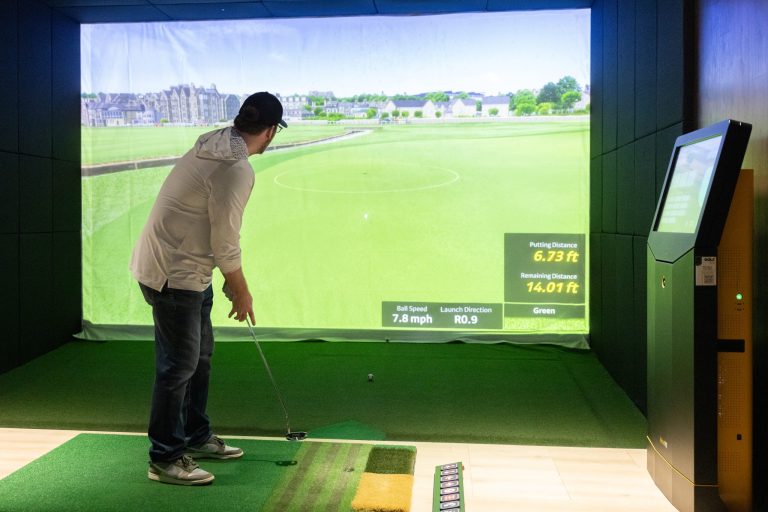
You have just striped a driver down the middle on a simulator that went 267 yards, slight draw, landed exactly where you aimed. Then you get to the course, and the same swing produces something quite different. That gap between golf simulator accuracy and real golf is the question most golfers have, but rarely get a straight answer to. The truth is more nuanced than that because what a high-quality simulator measures is genuinely precise. Where the real-world transfer breaks down has less to do with the technology and more to do with what the technology cannot replicate: real turf, wind, uneven lies, and the mental game under pressure. This guide answers how accurate are golf simulators honestly.
Quick Answer: How Accurate Are Modern Golf Simulators?
Golf simulator accuracy on premium systems sits within 1–3% of real-world ball flight data for key metrics like ball speed, launch angle, and carry distance. Golf club path, face angle, and golf sim spin rate accuracy are captured to within fractions of a degree. So where simulators diverge from real golf is not in the data; it is in the physical conditions they cannot replicate: turf interaction, wind, and uneven lies. For swing mechanics and ball-striking feedback, a well-calibrated system is as reliable as a professional launch monitor on a driving range.
Golf Simulator vs Real Golf: What’s More Accurate?
Golf simulator vs real golf is not about which is more accurate; it is about what each environment is good for. Simulators are better for swing mechanics, data-driven improvement, and consistent feedback. Whereas, real courses are better for developing feel, managing uneven lies, and playing under pressure.
| Factor | Golf Simulator | Real Course |
| Distance accuracy | Golf simulator distance accuracy is within 1–3% on the carry distance for calibrated premium systems | Affected by wind, altitude, humidity, and ball type |
| Shot shape | Club path and face angle captured accurately; virtual curve is highly reliable | Real spin interacts with air and wind variably |
| Club selection | Data matches real distances closely on premium systems; helps calibrate gapping | Real-world conditions may shift actual carry by 5–15 yards vs indoor data |
| Swing feedback | Immediate, measurable, and repeatable, no guesswork | Visual-only; difficult to self-diagnose without a coach or camera |
| Practice sessions | Controlled, weather-independent, data-rich | Variable conditions, harder to isolate specific improvements |
What Does a Golf Simulator Measure, and How Reliable Is It?
The accuracy of any golf simulator depends entirely on what is doing the measuring and how well it has been set up. Not all systems are equal; the gap between an entry-level setup and a professional platform is significant. Here is what the key components actually do and how they affect reliability so that you can consider them when planning to get a golf simulator.
Tracking Technology: Radar vs Camera Systems
Radar-based systems emit a continuous microwave signal that tracks the ball and club through the full flight arc. Camera-based systems capture the club and ball at impact using high-speed sensors. Both deliver high accuracy when correctly set up; radar tends to perform better in large spaces with full ball flight, while camera systems excel in compact indoor environments where full flight is not possible.
Number of Data Points Measured
Entry-level systems measure 8–12 data points. Professional systems like the Golf VX Quantum simulator capture over 20, including club path, face angle, attack angle, dynamic loft, spin axis, and ball speed simultaneously. More data points mean the system can cross-reference variables and produce a more accurate picture of what actually happened at impact.
Software Quality and Course Rendering
Even perfect hardware data can be degraded by weak software. The simulation software translates raw impact data into virtual ball flight; the physics engine, wind modeling, and terrain calculation all affect how faithfully that translation works. Golf VX’s proprietary platform renders over 19,000 undulation points per course, which is why Golf VX simulator accuracy holds up across varied terrain rather than just flat lies.
Calibration
A miscalibrated system produces consistently wrong data. Regular calibration, particularly after moving equipment or changing room conditions, is the single most controllable accuracy variable available to the user. A perfectly good launch monitor produces unreliable results if the sensor position has drifted.
Room Dimensions
For a golf simulator to work efficiently and accurately, ensuring proper room dimensions and the space required for the golf simulator is non-negotiable. A minimum ceiling height of 10 feet and a depth of 15 feet is needed for reliable full-swing data. Too little depth limits radar tracking; too low a ceiling alters swing mechanics and produces results that do not reflect your actual swing outdoors.
How to Improve Golf Simulator Accuracy?
Improving golf simulator accuracy isn’t that hard. The biggest accuracy gaps on simulator data come from setup and maintenance issues, not from the technology itself. Indoor golf ball flight accuracy is largely within your control once the system is installed. Take a look at how you can improve your golf simulator accuracy.
- Use premium golf balls: Range balls fly shorter and spin differently than premium balls. Using range balls in a simulator produces data that does not reflect your real-course distances, so use the same ball you play on the course.
- Calibrate regularly: Run a full calibration check every few sessions, or whenever equipment has been moved. Even small sensor shifts degrade accuracy over time.
- Maintain proper room dimensions: Hitting in a space that is too tight forces a shortened swing. The accuracy of your golf swing will be accurate for that swing, but it will not reflect what you do on a real tee box with full freedom of movement.
- Ensure adequate lighting: Camera-based systems are sensitive to lighting conditions. Consistent, even light prevents shadow interference with sensor readings.
- Update software: Simulation platforms release regular updates that refine physics modeling and course data. Outdated software can introduce inaccuracies that have been corrected in newer builds.
- Follow the manufacturer’s setup guidelines: Hitting mat position, screen distance, and sensor placement all have specified tolerances. Operating outside those parameters introduces avoidable error.
Are Golf Simulators Accurate Enough to Improve Your Real Game?
Yes, and the evidence for this is consistent across amateur and professional players who use simulators as part of structured training. The key is to use the data deliberately rather than just play rounds without reviewing what the numbers are telling you. What simulators do well for improvement is:
- Consistent feedback: Every shot produces measurable data.
- More repetitions: No weather delays, no tee times, more swings per hour.
- Swing analysis: Golf attack angle, face angle, and path data pinpoint causes, not just symptoms.
- Data-driven improvement: Trackable progress over sessions, not just feel.
- Year-round practice: No off-season, no skill regression over winter months.
| Can simulators improve real game performance? Research and coaching experience consistently show that data-guided practice produces faster improvement than feel-based range sessions. Indoor golf practice structured around specific swing metrics transfers directly to on-course performance. |
Experience the Most Realistic Golf Experience with GolfVX’s Simulator Accuracy
If you want to experience indoor golf accuracy that holds up against real-course standards, Golf VX delivers it. With 380+ world-famous courses available across Golf VX locations, where every session gives you course management practice on courses that actually exist. It lets you compete in leagues, enter tournaments, enjoy membership, and attend private events, along with amazing food and beverages. So, just book your bay for a private practice session or a fun evening with your friends and family through Golf VX events. And the rest, the technology handles the accuracy, and you bring the swing.
Conclusion
Golf simulator accuracy on premium systems is close enough to real-world conditions to produce genuinely useful swing data, reliable distance figures, and meaningful handicap improvement. The gap between the simulator and the course lies not in the numbers but in the physical variables that no indoor system can replicate. So use a simulator for what it does best: consistent, data-driven practice. Use the course for what it does best: feel, adaptability, and competitive play. The two are complements, not substitutes, so use them accordingly.
FAQs
How Close Does Indoor Golf Feel Compared To Playing Outside?
Premium simulators replicate swing data and ball flight very closely. What they cannot replicate is the feel of real turf, natural wind, uneven lies, and the psychological pressure of a real competitive round. When it comes to swing mechanics and distance calibration, the experience is closely comparable.
Can You Lower Your Handicap By Only Practicing On A Simulator?
Yes, several studies and coaching programs have documented meaningful simulator handicap improvement through simulator-only training, particularly for swing mechanics, ball-striking consistency, and distance control. Combining simulator practice with occasional real-course play accelerates improvement faster than either alone.
How Accurate Is Trackman Compared To A Real Driving Range?
Trackman is the industry benchmark for launch monitor accuracy, used by PGA Tour players and teaching professionals worldwide. On a real driving range, Trackman accuracy is extremely high. In an indoor simulator environment, its performance is comparable, with minor adjustments for the absence of full ball flight data in compact spaces.
Is Simulator Golf Good Enough For Serious Golfers?
Yes. Tour players, scratch amateurs, and competitive club golfers regularly use simulators for structured training. The data quality on systems like the Golf VX Quantum matches what professional coaching facilities use. For winter training, swing development, and specific fault correction, simulators are as rigorous as any other training environment.
How Much Space Do I Need For Accurate Simulator Results?
Minimum recommended dimensions are 10 feet ceiling height, 12 feet wide, and 15 feet deep. Tighter spaces force swing modifications that affect data accuracy. The numbers will be accurate for that modified swing, but they won’t reflect your full natural swing mechanics.
Are Golf Simulators Accurate Indoors?
Yes, indoor environments are actually ideal for camera-based systems because controlled lighting and the absence of wind produce consistent conditions for sensor readings. Radar systems also perform reliably indoors, provided there is sufficient room depth.